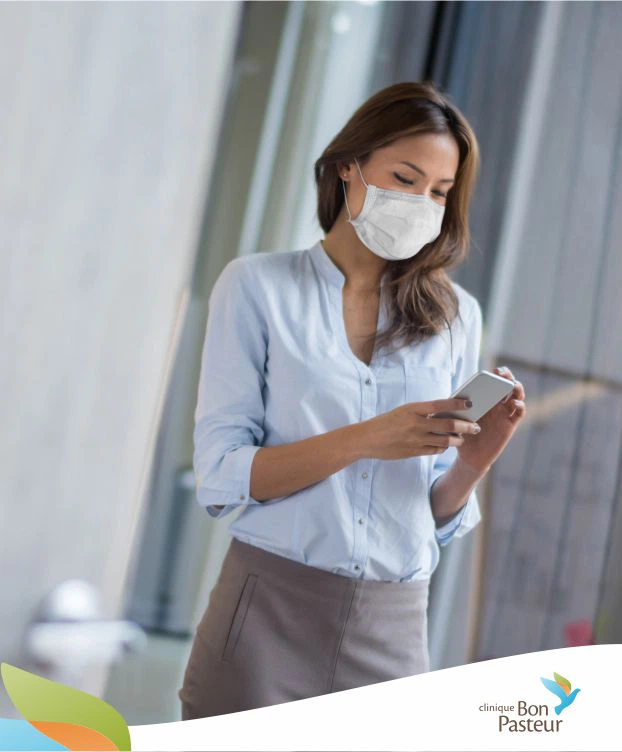
The World Mobile Phone Free Week is starting today! For some, if not most of us, the mere idea of a smartphone free day is almost unfathomable. However, we will be talking about our eyes’ health this month, so we would like to be all eyes on the impact of excessive smartphone use on our eyes, or more specifically, the impact, and solutions of smartphone use on our sight.
Nomophobia … No, this is not a controversial debate on gender dynamics, but rather the angst of not having our cell phone within reach. Ironically, the phone that was once used for the sole purpose of making phone calls is used today mostly for other reasons : to follow and answer emails, manage our time table, watch videos on Youtube, do an online search, follow our virtual or real friends through Facebook, Twitter, Whatsapp, Instagram, etc. No wonder why most of us have now become nomophobes.
The results on our eyes include visual disturbances, sleep disturbance, a damaged retina caused by our screen’s blue light, among others. With the 2010s’ being dubbed “the smartphone decade”, it goes without saying that we cannot yet have a bird’s eye view on smartphones’ impacts on our long-term health, especially our eyes’ health. However, quite a few studies have been done on this matter.
Blue light’s impact
According to a recent study, blue light emanating from smartphones, tablets, or laptops is harmful for the retina, causing premature reduced vision. In other words, we may gradually lose our eyesight, because this blue light damages the cells of the retina. These damaged cells do not regenerate, and this would cause aging of the eyesight.
And if you cannot get a wink of sleep at night and have bags under your eyes when you wake up in the morning, look no further! Blue light also has a detrimental impact on our sleep, because it disrupts our sleep cycle if we use our cell phone or tablet excessively in the evening before going to bed.
Other publications report asthenopia, or eyestrain, which is said to be caused by the eyes’ dryness. Smartphone use reduces the frequency with which we blink, a move that usually lubricates our eyes.
With the use of smartphones, tablets, or laptops, our eyes have to accommodate rapidly, adding to the eyestrain. Thus, due to the different character sizes between SMS, emails, online articles, the difference in brightness between these different devices, or the shortening of the distance between our eyes and what we read on our devices, our eyes’ activity increases.
Let’s look for solutions!
But how do we manage this impact on our sight in a digital society where we are increasingly confronted to digital devices? The reality is such that we can hardly do without our smartphone now.
There are thus different ways to deal with it, including:
• -by activating the blue light filter on our smartphone or tablet, or by using specific applications for the same result
• -by making the effort of blinking more often in front of our digital devices. By blinking often (and for more than a second), the eyes stay moist and dryness and irritation are reduced.
• -by applying the 20-20-20 rule, that is to say by having a quick break of 20 seconds every 20 minutes and staring at an object 20 feet (about 6 meters) away
• -by keeping our smartphone at least 40 to 50 cm from our eyes, because we sometimes hold it only 20 cm away.
• -by reducing the amount of time we are exposed to smartphones and avoiding its use at least one hour before sleep
• -by using eyeglass lenses especially designed for blue light protection, (whether we need optical correction or not), and which are available from certain opticians.
So, whether you want to have eagle’s eyes or be as blind as a bat, it’s up to you to choose! In the meantime, if this information has been an eye opener for you and should you require additional information, or advice / exams, feel free to call Clinique Bon Pasteur at 401-9500, and in the blink of an eye, one of the ophthalmologists on duty there will be happy to assist you.





We are dedicating this month of February to ophthalmology ! However, love is blind, and we surely can’t take our eyes off of that special person on this February 14, made famous by a certain St.Valentine. Much less glamorous, however, are the medical issues that can come with love, especially sexually transmitted infections. Syphilis, gonorrhea, hepatitis, HIV, chlamydia, so many names that can have you shuddering, or on the other hand, leave you totally indifferent. Although neither panic nor indifference can help, a minimum of understanding and above all precaution is necessary if you are to protect yourself, and those you love.
Across the world today, a sexually transmitted infection (STI) is transmitted to over a million people every single day. The sneakiest thing about STIs is that the majority of them have no symptoms, or mild symptoms that we might not actually link to an STI. In Mauritius, according to the 2019 health statistics report from the Ministry of Health, new cases of STIs were mainly about human immunodeficiency virus (HIV), syphilis, gonorrhea, genital warts, and herpes.
Transmission
As the name suggests, sexually transmitted infections can be acquired during unprotected sex (vaginal, oral or anal) with someone who has an STI. Some STIs can also be acquired through blood transfusions, or from mother to child before, during or after childbirth.
Symptoms
The most common symptoms of an STI include discharge from the vagina or penis, painful urination, genital ulcers and abdominal pain. However, one can have an STI without any noticeable symptoms, or without symptoms appearing for several years. Thus, not seeing any abnormality in or around the genitals doesn’t necessarily mean one is STI-free.
Am I at risk?
Generally speaking, if you have had unprotected sex, there is a risk of STI transmission. In addition, if a person has no symptoms, but has a sexual partner who has contracted or is showing symptoms of an STI, they are strongly advised to seek medical advice as well. It should be noted that females are disproportionately affected by STIs as compared to males. In addition, in females, STIs are less visible because they often come without symptoms.
Impact on health
The fact that there is a cure for many STIs should not be a reason to lower our guard, or neglect our sexual health. It should also be remembered that STIs can cause sterility (chlamydia or gonorrhea), can cause cervical cancer (the human papillomavirus, or HPV), or cause neonatal death, or stillbirths (syphilis) among others.
Prevention of STIs
The greatest danger of STIs remains a lack of public knowledge on this subject. In addition, the stigma associated with STIs is a factor that hinders access to medical care. It is thus important to learn about it and talk about it with others, especially as a couple, and with your adolescents as well. Above all, feel free to consult a health professional if in doubt. It is to be noted that the systematic use of a condom with each intercourse is an effective way to protect yourself from STIs. Let’s not forget to mention that being faithful, when it goes both ways within the couple, is the best way to protect yourself, as long as neither of the 2 people already has an STI.
Treatments
Some STIs, (including chlamydia, gonorrhea, syphilis, and trichomoniasis) can be treated with antibiotics. As for HIV and herpes, they can be treated with anti-virals, although these treatments cannot cure the disease, but slow down or halt its progression. It should be noted that some STIs (gonorrhea in particular) have grown resistant to antibiotics, which complicates their treatment, hence the importance of protecting yourself, getting tested and getting treated quickly in case of transmission. As for vaccines, there are currently effective preventive vaccines against hepatitis B and HPV infection, but conditions apply.
But let’s get back to celebrating love! Isn’t that a proof of one’s love to be in good health, especially to enjoy good sexual health, in order to protect the one we love? If you think you are at risk, do not turn a blind eye on it, but call Bon Pasteur clinic at 401-9500. You can meet your doctor, alone or as a couple. For your health, that of your partner and your family. In short, for those you love!